
Our Micro Accounts: How we save for expected expenses
A LONG time ago, I wrote a post on our cash envelope categories and what works for us. At that time, I promised to post about our micro accounts! This is that post. FINALLY, right?
Let’s recap. I’m writing these posts to demystify the topic, not because I think I know everything or because we are doing it all right. I’ll be the first to tell you that we made some poor decisions back when we were DINKs (double income, no kids) and we have major regrets that we hope others will learn from. Perhaps I’ll post about some of those some day (nothing life shattering, but stupid, nonetheless). Basically, we know that people have a hard time talking about money, which really sucks when you are trying to get a handle on your finances and you have NO idea where to start. Why does it have to be so secretive?! I mean, seriously, people?
You could make your life a ton easier and just take a Financial Peace course at a local church like my sister and her hubby did. I’m so thankful they took that course, because my sister shared her knowledge with me and started us on our debt free journey. I have not taken that course, but I did read Dave Ramsey’s Total Money Makeover book and it was pretty inspiring. (You can probably pick one up at your church library, public library or Goodwill.)
We don’t follow everything Dave recommends, but we do like a lot of what he says, like the parts about getting rid of credit cards, using cash for all of our everyday expenses and planning for expected expenses.
For example, Mitch has a business credit card that he keeps with him, but our personal credit card (just one) is frozen in a cup of ice in the freezer. We just don’t need it. Ever. We have debit cards if we ever need to use one for some reason (car rental, online shopping, airplane tickets, etc), but otherwise, we are off the monthly-credit-card-use-hamster-wheel. FREEDOM. Truly.
That is all due to our use of the cash envelope system, which I’ve written about at length. Go read about that. I’ll wait.
We use online bill pay to pay for monthly expenses like mortgage, debt payoff, insurance, utilities, tithe and offerings, etc.
We regularly contribute to our retirement accounts (right off the top of Mitch’s paycheck and at tax time) and have a lot of life insurance (term and whole life).
And now for the micro accounts: This is just what works for us, and hopefully it will spark some ideas for you.
Two years ago, we fully funded our little emergency fund account ($1000). We have never had to dip into it (thank you, Lord!) but if there is ever a true emergency, then it is there. Needing a new microwave because ours broke is NOT an emergency (although it might have felt like it at the time). An emergency must be serious business.
Last year, we made it a priority to fully fund our Health Savings account. Our family health deductible is $2000, so we funded it up to $2000. We do sometimes have to dip into it to pay doctor’s bills, but we immediately work to build it back up again by depositing $50 a month until it is fully funded. These two steps took a load of stress off.
After that, we started setting aside money for expected expenses. These are things that we know are coming, but they used to “sneak up” on us, which is pretty ridiculous, but it is what it is.
For example, we pay our entire homeowner’s insurance payment every February. It’s a chunk of money that used to STRESS me out, but these days I save $100 a month for homeowners insurance. Our homeowner’s insurance is much less than that, but last year I undersaved, so this year I popped it up to $100 so that we would have cushion. I like security.
We have a Home Maintenance budget category on my micro account spreadsheet that we contribute $50 a month toward. We don’t live in a fixer-upper, but there are always things breaking and projects needing to be done, so we budget for it. I want new bark dust this summer, and I just realized that I have the money saved! Wahoo! {doing the happy dance!} You know that microwave emergency? The replacement money came out of the Home Maintenance account.
Next is Vehicle Registration, which I totally over-save for. I can’t remember how much it is, but I save $15 a month so that when registration comes around I’m ready to go.
Our Car Maintenance fund gets a bit of a workout. We have two 15+ year old vehicles, and they are falling apart. My Jeep doesn’t have air conditioning and Mitch’s truck doesn’t have heat. So, we drive the family around in the truck in the summer and in the Jeep in the winter! LOL! They still run, thanks to regular oil changes, and if they ever need tires, I’m ready for that expense. We save $50 a month for this fund.
We love to get our kids gifts, but birthdays and Christmas used to be so stressful. We were never big credit card users (when it came to extravagant expenses, just life-sustaining expenses), so we didn’t rack up birthday or Christmas debt, but we didn’t buy our kids much, either. TRUE, Christmas isn’t all about the gifts, but when you love to give, it’s hard to not be able to do that. These days, we save $50 a month for Gifts. Discovering Swag Bucks was HUGE for my family, though. If saving for gifts isn’t gonna happen for you, consider earning $5 Amazon gift cards, just by switching your search engine to Swag Bucks. One year, I racked up $475 in Amazon Gift cards using Swag Bucks. I did use about $200 of those for an “emergency” household expense, but that was totally cool with me! 
Our final category in our Micro Account is Vacation. Our family vacations are usually weekend camping trips, a night at the drive-in movies, a day at the aquarium, a trip to visit my brother or sister, etc. Sometimes it’s, “We overspent at Thai food. Ah! Vacation budget!” Don’t judge. That’s how we work!! LOL! Seriously, though, we just went on a one week vacation at a timeshare in Lake Chelan, WA that was donated to us, and it was AWESOME to pull out $500 for gas, food, entertainment, eating out, etc. I have never been THAT relaxed about money on a vacation before. I highly recommend saving and paying cash rather than using your credit card. We save $100 a month for vacation. I realize that if we’re ever going to be able to take our kids to Disneyland, I’ll need to increase that amount, but I guess I’ll have to reevaluate that, now that I’ve paid off my student loans!! (Had to plug that. It’s just SO amazing to me! Hee, hee!)
Now, logistically, how do we manage these accounts? I know I’m old school, but I work with a spreadsheet. There are online savings accounts and various types of software available for micro accounts, but I’m confident in my spreadsheet, and it works for me.
We get paid once a month on the 15th, so when I deposit our check, I take our cash out for our envelopes, then go home and use online banking to transfer a chunk of money from our checking account to our savings account. Then, I open up our spreadsheet and enter the amounts in each of the categories. This is a screenshot of our monthly micro account. Click to enlarge it. (Oh, the transparency! You guys should really be thanking me for putting this out there! I feel sheepish. This is awkward.)
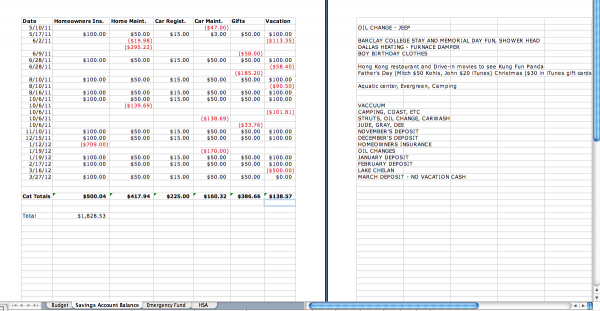
Notice that along the bottom I have the links to the other savings accounts. We actually have one checking account, and two savings accounts that I can access through online bill pay: one is our emergency fund and the other is this micro account which is a money market account. We also have our Health Savings Account through State Farm Bank.
You’ll also notice that there is a lot of money in our micro accounts. A lot for us, anyway. Most likely, we will not use all of the money in these accounts, so in December I’ll transfer all but the bare minimum over to another category that we’ll call vehicle savings. This is how we built up our HSA. It hadn’t been fully funded until we transferred excess from our micro accounts into the HSA last year.
Let me just continue to say that we do not have it all figured out, and we do still have ginormous HELOC debt, but we definitely feel financial freedom because we know where our money is going and we have a plan. We won’t be overwhelmed by an “unexpected” expense that we didn’t plan for, thanks to our micro accounts.
And, I also feel the need to tell you once again that we are a family of four, and we make a lot of sacrifices to be able to save, spend and give in this way. Every family is different, and what works for us may not work for you. You might make significantly more or less than we do. Our point is to simply show you what is possible and help you to get your thinkers thinking. We had many years of scraping by (or, not scraping by, but just crying our way through it and trying to breathe in and out), so we can sympathize with those of you who look at our spreadsheet or our cash envelope categories and feel hopeless. That’s how I felt when my sister shared her spreadsheet with me. What I learned is that the needs of her family (of eight) were VERY different from my family, and that I could do something to help make up the deficit between what we spent and what my husband brought home in his paycheck by cutting back on our grocery budget and cooking from scratch. SACRIFICE doesn’t have to be devastating. It can be empowering.
Yes, it does help that I have been working on building up my businesses (creating new income), and for that I am incredibly grateful to the Lord. He opened up opportunities for me and gave me ideas that have eventually paid off for our family, allowing me to bring in a wonderful little income that has been instrumental as we continue to pay off debt. Perhaps another post? I’ll have to think about that!
Let me know if you have any questions in the comments. I’ll let you know what works for us!
 Disclosure: This post may contain affiliate links. When you use them, you help support this site! Thank you!


 (No Ratings Yet)
 Loading ...
I just wanted to thank you for being so transparent as well as so encouraging. We’ve been working on the Dave Ramsey plan for a few years now-sometimes doing better than others but the debts are coming down. Thanks for sharing what works for you and congratulations on paying off those student loans.
[Reply]
I have an Excel spreadsheet that’s similar to yours for our “micro accounts” though I think you’re more organized. We save for Christmas/gifts, vacations, car insurance, and keep track of how much is in each “account” in Excel. I also keep track of exactly how bonuses and tax refunds are spent which has helped us a lot. We have friends who actually have micro accounts where each is a separate savings account (they have a bunch!) but it seems like an awful lot of work to maintain.
[Reply]
Kelleigh, Thank you for taking the time to share such personal information. I like living on a budget and work very hard at it. But your spreadsheet has inspired me to do better. My spreadsheet is similar but I like yours and will modify mine. I call my savings account for micro accounts my escrow account but I didn’t have it as detailed. I like yours, mine will be similar very soon. Thank you again and keep up the good work. God bless you and your family.
[Reply]
Thank you so much for this post! I was just wondering the other day on how to get started on saving up for these type of expenses as our car tags are due this month (sigh). I read Dave Ramsey’s book a couple of years ago and it was so inspiring that I started working on my monthly budget. But that’s as far as I got. I’m definitely going to try this idea as I think I could do this myself. Thanks for the inspiration! However, I do have one question. What kind of money market account would you recommend for this type of thing? I’m not familiar with money market accounts as I’ve never used one.
[Reply]
Kelleigh Reply:
April 23rd, 2012 at 7:42 am
Hi Kay! My bank calls it a Personal Money Market Account, and it works just like a savings account. It isn’t for investment purposes at all, in our case. We have other investment accounts. This is just something we set up to hold money longer-term than a regular savings account. I don’t know that it matters much, though, since the interest rate is pathetic! I treat it like a savings account, but I transfer to and from the account regularly. Hope that helps!
[Reply]
I like how you are tracking what Dave Ramsey would call sinking funds, using the Excel sheet. Thanks for sharing that.
For me it is helpful to have every single account in a different account. My small local bank allowed me to open 9 savings accounts with a $50 deposit each and no minimum. I have labeled each account the name of the sinking fund. This way when I log in to my account online I can see how much is in every account and how much I have total. It is very easy for me to transfer money if I need it, using my bank’s smartphone app.
[Reply]
Hi Kelleigh!
Thanks so much for your willingness to share something so personal. It helps to see how people use Dave Ramsey’s guidelines. I took his class a few years ago and it’s definitely helped in many ways. However, over the last couple of years I’ve not done the cash envelope system and really want to get back into that habit. (where are my princess/tiara/pink & black envelopes? - I keep watching your site for them!)
I’ve just recently been thinking of getting my spreadsheet fired back up - and the way you have yours set up is even better than what I had used. Thanks so much for sharing!
Sharon
[Reply]
I have been using the envelope system for a few years and have always micro-categorized them so I knew I could pay the car registration when the time came, the dog license, etc. If I had not planned, there would have been no way to take care of it when the time rolled around. It is nice to see that you have explained this to everyone so they too can lessen their chances of being stressed over money.
[Reply]
I’m glad you’re so transparent! Showing us exactly what you use. I love it. I’m also wondering if you would consider doing a post on your budget tab. You seem to have such a great system and like it wouldn’t be overly complicated like some other systems I’ve seen…
[Reply]
[...] already had a few hundred dollars in our vacation micro account, and our other micro accounts were either fully funded or looking pretty hefty, so we diverted all [...]
Thank you for the great (and simple) example! Dave Ramsey talks a lot about sinking funds but doesn’t really give the nuts and bolts about how to manage all of those little accounts without a personal accountant. I am teaching his class this winter and will use your example to help them see how it’s done!
[Reply]
Thanks for the great topic. I am $175 on JCP card before now debt except the house. Yes I really want to call Dave Ramsey and scream we are DEBT FREE! I like you never caught on the micro saving. I LOVE LOVE LOVE your envelope system. I will be spreading the word at work sending to the pinterest link and etsy site. I love talking about debt I think honesty about success and failure keeps me learning more and more.
[Reply]
I love your site!! My husband and I both work and we make pretty good money, annually we make a combined total of about $60-70,000 a year. But regretfully we are ending our year with a measly $200 in our savings account. We dont have any kids its just the 2 of us but I really want to get our finances in order before we expand our family. I just don’t know where to start! I guess the envelopes are where its at!! Wish me luck!!
[Reply]
Leave your response!
Want to keep up with my latest news and new releases? Subscribe to my newsletter today!
Check out My Latest Creations!:
Soap Box by Kelleigh Ratzlaff Designs: This adorable soap box can be filled with tiny soaps and pretty candies! $4.99
Hourglass Box by Kelleigh Ratzlaff Designs: This uniquely shaped box is the perfect size for gift cards and trinkets! $4.99
Cash Envelopes on Etsy!
My Sponsors:
Archives
Categories
Categories
Recent Comments
Most Commented
Most Viewed